|
Perforce Chronicle 2012.2/486814
API Documentation
|
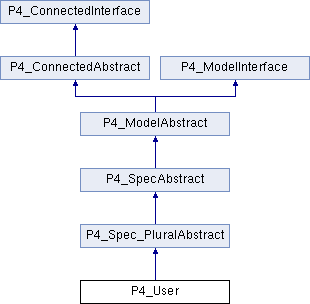
Abstracts operations against Perforce users. More...
Public Member Functions | |
| addToGroup ($group) | |
| Add this user to the named group. | |
| delete () | |
| Remove this user from Perforce. | |
| getAccessDateTime () | |
| Get the last access time for this user spec. | |
| getClients () | |
| Get an Iterator of all the Clients this user owns. | |
| getEmail () | |
| Get the user's email address. | |
| getFullName () | |
| Get the user's full name. | |
| getGroups () | |
| Get the names of groups that this user belongs to. | |
| getJobView () | |
| Get the user's job view (selects jobs for inclusion during changelist creation). | |
| getPassword () | |
| Get the in-memory password (if one is set). | |
| getReviews () | |
| Get the reviews for this client (depot paths to notify user of changes to). | |
| getUpdateDateTime () | |
| Get the last update time for this user spec. | |
| isPassword ($password) | |
| Test if the given password is correct for this user. | |
| save () | |
| Save this user to Perforce. | |
| setEmail ($email) | |
| Set the user's email address. | |
| setFullName ($name) | |
| Set the user's full name. | |
| setJobView ($jobView) | |
| Set the user's job view (selects jobs for inclusion during changelist creation). | |
| setPassword ($newPassword, $oldPassword=null) | |
| Set the user's password to the given password. | |
| setReviews ($reviews) | |
| Set the reviews for this user (depot paths to notify user of changes to). | |
Static Public Member Functions | |
| static | exists ($id, P4_Connection_Interface $connection=null) |
| Determine if the given user id exists. | |
| static | fetchAll ($options=array(), P4_Connection_Interface $connection=null) |
| Get all users from Perforce. | |
| static | isAutoUserCreationEnabled (P4_Connection_Interface $connection=null) |
| Check if automatic user creation is enabled. | |
Public Attributes | |
| const | FETCH_BY_NAME = 'name' |
Protected Member Functions | |
| _setPassword ($newPassword, $oldPassword=null, P4_Connection_Interface $connection=null) | |
| Immediately set the user's password to the given password. | |
Static Protected Member Functions | |
| static | _fromSpecListEntry ($listEntry, $flags, P4_Connection_Interface $connection) |
| Given a spec entry from spec list output (p4 users), produce an instance of this spec with field values set where possible. | |
| static | _getFetchAllFlags ($options) |
| Produce set of flags for the spec list command, given fetch all options array. | |
| static | _isValidId ($id) |
| Check if the given id is in a valid format for user specs. | |
Static Protected Attributes | |
| static | $_accessors |
| static | $_idField = 'User' |
| static | $_mutators |
| static | $_specType = 'user' |
Abstracts operations against Perforce users.
The P4 User class differs from the 'user' spec definition in that it does not have a password field. This is because the password does not behave like other fields. To change a user's password, use the setPassword() function. To test if a given string matches a user's password, use the isPassword() method. It is not possible to get a user's password.
| static P4_User::_fromSpecListEntry | ( | $ | listEntry, |
| $ | flags, | ||
| P4_Connection_Interface $ | connection | ||
| ) | [static, protected] |
Given a spec entry from spec list output (p4 users), produce an instance of this spec with field values set where possible.
| array | $listEntry | a single spec entry from spec list output. |
| array | $flags | the flags that were used for this 'fetchAll' run. |
| P4_Connection_Interface | $connection | a specific connection to use. |
Reimplemented from P4_Spec_PluralAbstract.
    {
        // update/access time are return as longs. Unset to avoid figuring out timezone
        // for a proper conversion.
        unset($listEntry['update']);
        unset($listEntry['access']);

        return parent::_fromSpecListEntry($listEntry, $flags, $connection);
    }
| static P4_User::_getFetchAllFlags | ( | $ | options | ) | [static, protected] |
Produce set of flags for the spec list command, given fetch all options array.
Extends parent to add support for filter option.
| array | $options | array of options to augment fetch behavior. see fetchAll for documented options. |
Reimplemented from P4_Spec_PluralAbstract.
    {
        $flags = parent::_getFetchAllFlags($options);

        if (isset($options[static::FETCH_BY_NAME])) {
            $name = $options[static::FETCH_BY_NAME];

            if ((!is_array($name) || !count($name)) && (!is_string($name) || trim($name) === "")) {
                throw new InvalidArgumentException(
                    'Filter by Name expects a non-empty string or an non-empty array as input'
                );
            }

            // if array is given, ensure values are non-empty strings
            if (is_array($name)) {
                $names    = $name;
                $filtered = array_filter($names,    'is_string');
                $filtered = array_filter($filtered, 'trim');

                if (count($names) !== count($filtered)) {
                    throw new InvalidArgumentException(
                        'Filter by Name expects all names in the input array to be non-empty strings'
                    );
                }
                $flags = array_merge($flags, $names);
            } else {
                $flags[] = $name;
            }
        }

        return $flags;
    }
| static P4_User::_isValidId | ( | $ | id | ) | [static, protected] |
Check if the given id is in a valid format for user specs.
| string | $id | the id to check |
Reimplemented from P4_Spec_PluralAbstract.
    {
        $validator = new P4_Validate_UserName;
        return $validator->isValid($id);
    }
| P4_User::_setPassword | ( | $ | newPassword, |
| $ | oldPassword = null, |
||
| P4_Connection_Interface $ | connection = null |
||
| ) | [protected] |
Immediately set the user's password to the given password.
If the current password is given, it will be validated.
| string | $newPassword | the new password. |
| string | $oldPassword | optional - existing password. |
| P4_Connection_Interface | $connection | optional - a specific connection to use. |
| P4_Exception | if the password can't be set. |
    {
        $input = array();

        // if caller supplied an old password, prepend it to input array.
        if ($oldPassword) {
            $input[] = $oldPassword;
        }

        // always confirm old password
        $input[] = $newPassword;
        $input[] = $newPassword;

        // if no connection given, use default.
        $connection = $connection ?: $this->getConnection();

        // if not connected as this user, supply user id.
        $flags = array();
        if ($connection->getUser() !== $this->getId()) {
            $flags[] = $this->getId();
        }

        // attempt to set password.
        $result = $connection->run("password", $flags, $input);

        // change connection credentials if password for connected user has been changed
        // if we don't do this automatically, subsequent commands will fail when using
        // the command-line connection, but would succeed using the P4PHP extension.
        if ($connection->getUser() === $this->getId()) {
            $connection->setPassword($newPassword);
            if ($connection->getTicket()) {
                $connection->login();
            }
        }

        return $this;
    }
| P4_User::addToGroup | ( | $ | group | ) |
Add this user to the named group.
| string | $group | the name of the group to add the user to. |
    {
        $group = P4_Group::fetch($group, $this->getConnection())
            ->addUser($this->getId())
            ->save();

        return $this;
    }
| P4_User::delete | ( | ) |
Remove this user from Perforce.
| P4_Spec_Exception | if no id has been set. |
    {
        if ($this->getId() === null) {
            throw new P4_Spec_Exception("Cannot delete. No id has been set.");
        }

        // initialize command flags with first arg.
        $flags = array("-d");

        // if we are connected with super user privileges, add in the -f flag.
        // otherwise, if not connected as this user, connect as this user.
        $connection = $this->getConnection();
        if ($connection->isSuperUser()) {
            $flags[] = "-f";
        } else if ($connection->getUser() != $this->getId()) {
            $connection = P4_Connection::factory(
                $connection->getPort(),
                $this->getId()
            );
        }

        // issue delete user command.
        $flags[] = $this->getId();
        $result = $connection->run(static::_getSpecType(), $flags);

        // should re-populate.
        $this->_deferPopulate(true);

        return $this;
    }
| static P4_User::exists | ( | $ | id, |
| P4_Connection_Interface $ | connection = null |
||
| ) | [static] |
Determine if the given user id exists.
| string | $id | the id to check for. |
| P4_Connection_Interface | $connection | optional - a specific connection to use. |
Reimplemented from P4_Spec_PluralAbstract.
    {
        // check id for valid format
        if (!static::_isValidId($id)) {
            return false;
        }

        $users = static::fetchAll(
            array(
                static::FETCH_BY_NAME => $id,
                static::FETCH_MAXIMUM => 1
            ),
            $connection
        );

        return (bool) count($users);
    }
| static P4_User::fetchAll | ( | $ | options = array(), |
| P4_Connection_Interface $ | connection = null |
||
| ) | [static] |
Get all users from Perforce.
Adds filtering option.
| array | $options | optional - array of options to augment fetch behavior. supported options are: |
FETCH_MAXIMUM - set to integer value to limit to the first 'max' number of entries. FETCH_BY_NAME - set to user name pattern (e.g. 'jdo*'), can be a single string or array of strings.
| P4_Connection_Interface | $connection | optional - a specific connection to use. |
Reimplemented from P4_Spec_PluralAbstract.
    {
        $connection = $connection ?: static::getDefaultConnection();

        // if not fetching by name, defer to parent
        if (!isset($options[static::FETCH_BY_NAME])) {
            return parent::fetchAll($options, $connection);
        }

        // get fetch max option and uset it from the options as we handle it manually
        $max = isset($options[static::FETCH_MAXIMUM]) ? $options[static::FETCH_MAXIMUM] : 0;
        unset($options[static::FETCH_MAXIMUM]);

        // sort names before fetching users from the server, so if max is set
        // we get the first max users (according to case-sensitivity of server)
        $names = (array) $options[static::FETCH_BY_NAME];
        if ($connection->isCaseSensitive()) {
            sort($names);
        } else {
            usort($names, 'strcasecmp');
        }

        // fetch users in several (as few as possible) runs as
        // there is a potential to exceed the arg-max on this command
        $users = new P4_Model_Iterator;
        foreach ($connection->batchArgs($names) as $batch) {
            $options[static::FETCH_BY_NAME] = $batch;
            foreach (parent::fetchAll($options, $connection) as $user) {
                $users[] = $user;

                // exit loop if we've reached the max limit
                if ($max && $users->count() == $max) {
                    break(2);
                }
            }
        }

        return $users;
    }
| P4_User::getAccessDateTime | ( | ) |
Get the last access time for this user spec.
This value is read only, no setAccessTime function is provided.
If this is a brand new spec, null will be returned in lieu of a time.
    {
        return $this->_getValue('Access');
    }
| P4_User::getClients | ( | ) |
Get an Iterator of all the Clients this user owns.
| P4_Spec_Exception | If no ID is set for this user |
    {
        if (!static::_isValidId($this->getId())) {
            throw new P4_Spec_Exception("Cannot get clients. No user id has been set.");
        }

        return P4_Client::fetchAll(
            array(P4_Client::FETCH_BY_OWNER => $this->getId()),
            $this->getConnection()
        );
    }
| P4_User::getEmail | ( | ) |
Get the user's email address.
    {
        return $this->_getValue('Email');
    }
| P4_User::getFullName | ( | ) |
Get the user's full name.
    {
        return $this->_getValue('FullName');
    }
| P4_User::getGroups | ( | ) |
Get the names of groups that this user belongs to.
    {
        if (!static::_isValidId($this->getId())) {
            throw new P4_Spec_Exception("Cannot get groups. No user id has been set.");
        }

        return P4_Group::fetchAll(
            array(P4_Group::FETCH_BY_MEMBER => $this->getId(), P4_Group::FETCH_INDIRECT),
            $this->getConnection()
        );
    }
| P4_User::getJobView | ( | ) |
Get the user's job view (selects jobs for inclusion during changelist creation).
    {
        return $this->_getValue('JobView');
    }
| P4_User::getPassword | ( | ) |
Get the in-memory password (if one is set).
    {
        $password = $this->_getValue('Password');
        return is_array($password) ? $password[0] : null;
    }
| P4_User::getReviews | ( | ) |
Get the reviews for this client (depot paths to notify user of changes to).
    {
        return $this->_getValue('Reviews') ?: array();
    }
| P4_User::getUpdateDateTime | ( | ) |
Get the last update time for this user spec.
This value is read only, no setUpdateTime function is provided.
If this is a brand new spec, null will be returned in lieu of a time.
    {
        return $this->_getValue('Update');
    }
| static P4_User::isAutoUserCreationEnabled | ( | P4_Connection_Interface $ | connection = null | ) | [static] |
Check if automatic user creation is enabled.
| P4_Connection_Interface | $connection | optional - a specific connection to use. |
| P4_Exception | if we exceed the maximum number of unlikely usernames |
    {
        // if no connection given, use default.
        $connection = $connection ?: static::getDefaultConnection();

        $port = $connection->getPort();

        // limit the number of 'unlikely' username lookups to 3.
        $maxLookups = 3;
        for ($i = 0; $i < $maxLookups; $i++) {
            // generate an unlikely user name.
            $username = md5(mt_rand());

            // try to run p4 users as the unlikely user
            // (perforce won't create an account for this lookup).
            try {
                $connection = P4_Connection::factory($port, $username);
                $result = $connection->run('users', $username);
            } catch (P4_Connection_CommandException $e) {
                return false;
            }

            // ensure unlikely user doesn't exist.
            if (!$result->getData()) {
                return true;
            }
        }

        throw new P4_Exception(
            "Failed to determine if auto user creation is enabled."
          . "Exceeded the maximum of $maxLookups 'unlikely' username lookups."
        );
    }
| P4_User::isPassword | ( | $ | password | ) |
Test if the given password is correct for this user.
| string | $password | the password to test. |
    {
        $p4 = P4_Connection::factory(
            $this->getConnection()->getPort(),
            $this->getId(),
            null,
            $password
        );

        try {
            $p4->login();
            return true;
        } catch (P4_Connection_LoginException $e) {
            return false;
        }
    }
| P4_User::save | ( | ) |
Save this user to Perforce.
This will not save changes to the password field. Passwords must be set via setPassword().
| P4_Spec_Exception | if no id has been set. |
Reimplemented from P4_SpecAbstract.
    {
        // ensure all required fields have values.
        $this->_validateRequiredFields();

        // set 'password' field to '******' otherwise password
        // will be deleted under certain security levels.
        $values = $this->_getValues();
        $values['Password'] = '******';

        // initialize command flags with first arg.
        $flags = array("-i");

        // if we are connected with super user privileges, add in the -f flag.
        // otherwise, if not connected as this user, connect as this user.
        $connection = $this->getConnection();
        if ($connection->isSuperUser()) {
            $flags[] = "-f";
        } else if ($connection->getUser() != $this->getId()) {
            $connection = P4_Connection::factory(
                $connection->getPort(),
                $this->getId()
            );
        }

        // send user spec to server.
        $password = $this->_getValue('Password');
        try {
            $connection->run(static::_getSpecType(), $flags, $values);
        } catch (P4_Connection_CommandException $e) {

            // if saving user failed because password has not been
            // set, and the caller supplied a password, try setting
            // the password first, then saving user again.
            //
            // @todo This workaround relies on the fact, that user has been created although previous
            // command had failed. At the moment it seems, that when adding a new user (with non-superuser
            // connection) this error cannot be avoided.
            $errors = $e->getResult()->getErrors();
            if (stristr($errors[0], "password must be set") && is_array($password) && isset($password[0])) {
                $this->_setPassword($password[0], null, $connection);
                $connection->run(static::_getSpecType(), $flags, $values);
                // avoid redundant password change
                $password[0] = null;
            } else {
                throw $e;
            }
        }

        // change the users password if they have set a new one.
        if (is_array($password) && $password[0] !== null) {
            $this->_setPassword($password[0], $password[1], $connection);
        }

        // should re-populate (server may change values).
        $this->_deferPopulate(true);

        return $this;
    }
| P4_User::setEmail | ( | $ | ) |
Set the user's email address.
We don't require a valid email address here because Perforce doesn't enforce one. If we did then users with invalid emails would be innaccessible.
| string | null | the email of the user. |
| InvalidArgumentException | if given email is not a string. |
    {
        if ($email !== null && !is_string($email)) {
            throw new InvalidArgumentException("Cannot set email. Invalid type given.");
        }
        return $this->_setValue("Email", $email);
    }
| P4_User::setFullName | ( | $ | name | ) |
Set the user's full name.
| string | null | $name | the full name to give the user. |
| InvalidArgumentException | if given name is not a string. |
    {
        if ($name !== null && !is_string($name)) {
            throw new InvalidArgumentException("Cannot set full name. Invalid type given.");
        }
        return $this->_setValue('FullName', $name);
    }
| P4_User::setJobView | ( | $ | jobView | ) |
Set the user's job view (selects jobs for inclusion during changelist creation).
| string | null | $jobView | the user's job view. |
| InvalidArgumentException | if given job view is not a string. |
    {
        if ($jobView !== null && !is_string($jobView)) {
            throw new InvalidArgumentException("Cannot set job view. Invalid type given.");
        }
        return $this->_setValue("JobView", $jobView);
    }
| P4_User::setPassword | ( | $ | newPassword, |
| $ | oldPassword = null |
||
| ) |
Set the user's password to the given password.
Does not take effect until save() is called.
| string | null | $newPassword | the new password string or null to clear in-memory password. |
| string | $oldPassword | optional - existing password. |
    {
        $this->_setValue('Password', array($newPassword, $oldPassword));

        return $this;
    }
| P4_User::setReviews | ( | $ | reviews | ) |
Set the reviews for this user (depot paths to notify user of changes to).
Reviews is passed as an array of filespec strings.
| array | $reviews | Review entries - an array of filespec strings. |
| InvalidArgumentException | if reviews is not an array. |
    {
        if (!is_array($reviews)) {
            throw new InvalidArgumentException('Reviews must be passed as array.');
        }

        return $this->_setValue('Reviews', $reviews);
    }
P4_User::$_accessors [static, protected] |
 array(
        'Email'     => 'getEmail',
        'Update'    => 'getUpdateDateTime',
        'Access'    => 'getAccessDateTime',
        'FullName'  => 'getFullName',
        'JobView'   => 'getJobView',
        'Reviews'   => 'getReviews',
        'Password'  => 'getPassword',
    )
Reimplemented from P4_SpecAbstract.
P4_User::$_idField = 'User' [static, protected] |
Reimplemented from P4_Spec_PluralAbstract.
P4_User::$_mutators [static, protected] |
 array(
        'Email'     => 'setEmail',
        'FullName'  => 'setFullName',
        'JobView'   => 'setJobView',
        'Reviews'   => 'setReviews',
        'Password'  => 'setPassword',
    )
Reimplemented from P4_SpecAbstract.
P4_User::$_specType = 'user' [static, protected] |
Reimplemented from P4_SpecAbstract.
| const P4_User::FETCH_BY_NAME = 'name' |

